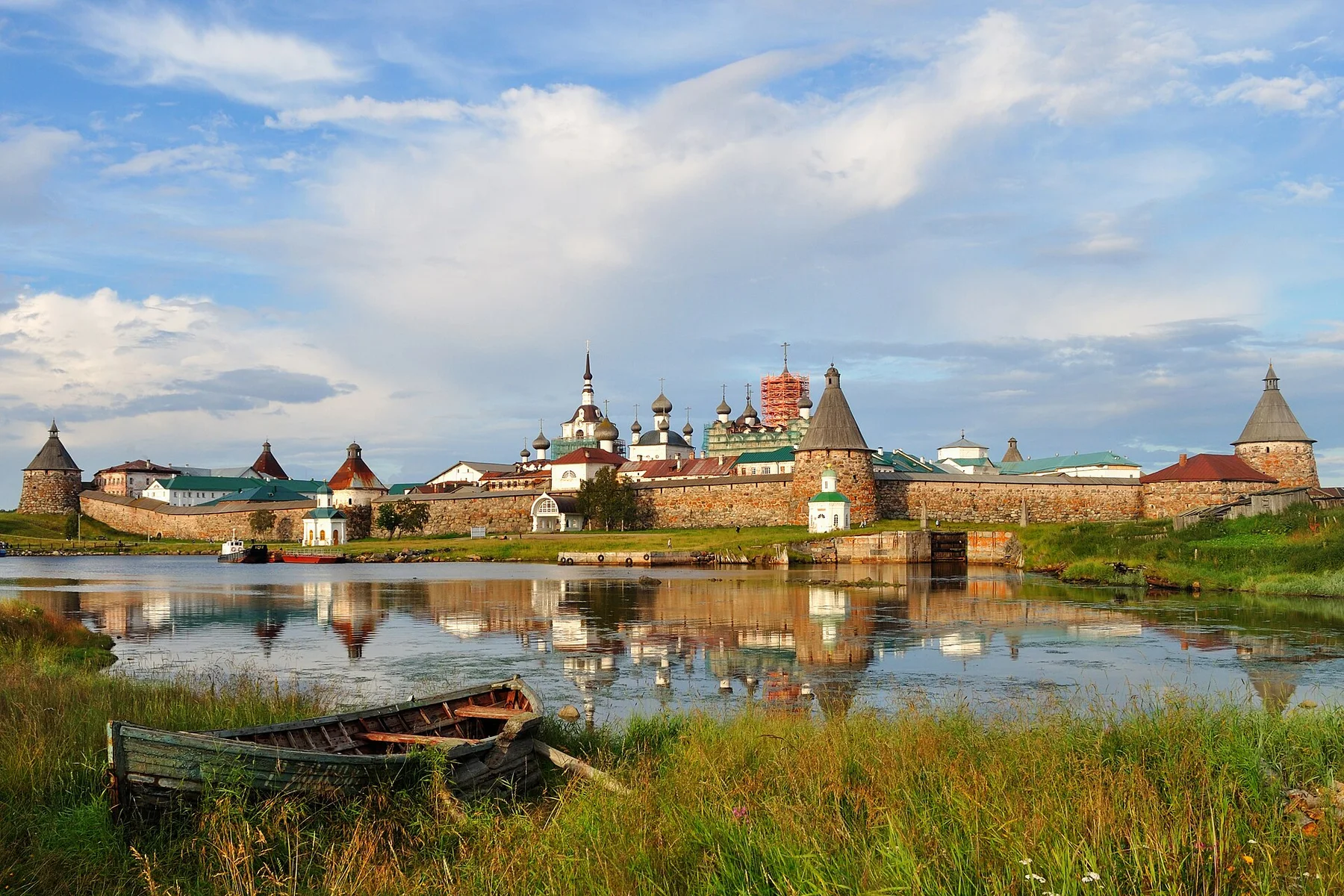
The most memorable experience is the sequence of water, timber houses and small painted chapels rather than a single monument.
Check opening days and local access before arrival, then connect the main historic site with the surrounding landscape on foot or by water.
Look a little closer
Worth discovering
The details that make Kenozero National Park different.
Destination view
01
Vershinino village
A hilltop chapel overlooks lake, fields and wooden houses.
Destination view
02
Painted chapel ceilings
Local sacred art survives in small rural buildings.
Destination view
03
Lake routes
Water remains the natural way to connect the dispersed settlements.
Photo journal
A closer look at Kenozero National Park
8 photographs
01Успенская церковь 1а02Kenozero National Park — view 203Никольская часовня в Вершинино 0304Никольская часовня в Вершинино 0105Никольская часовня в Вершинино 0206Часовня Афанасия архиепископа Александрийского, д. Тарасово07Часовня Трёх Святителей Вселенских, д.Немята08Успенская церковь 2а
The full story
How time shaped Kenozero National Park
Lake villages, painted chapel ceilings, sacred groves and traditional boat routes survive in a northern Russian cultural landscape. The deeper story links its visible features with the people and changes behind them.
4 min readArkhangelsk Oblast, Russia
Kenozero National Park is centred on Arkhangelsk Oblast, where lake villages, painted chapel ceilings, sacred groves and traditional boat routes survive in a northern Russian cultural landscape. The strongest reason to make the journey is to travel by wooden boat to a chapel village.
The strongest visual shorthand for Kenozero National Park is the experience described as “Travel by wooden boat to a chapel village”. Behind it lies a more complex relationship between physical processes, settlement and the modern idea of the place as a destination. The most memorable experience is the sequence of water, timber houses and small painted chapels rather than a single monument.
At Kenozero National Park, the form of the landscape explains many of the choices that came later. Built heritage, working settlement and surrounding land or water form one continuous cultural landscape. The approach and the space between sites are as important as the principal monument.
Movement is the organising idea at Kenozero National Park. “Vershinino village” explains how the route negotiates an obstacle that would otherwise divide the landscape. A hilltop chapel overlooks lake, fields and wooden houses.
02
Settlement and memory
The human landscape behind the scenery
Kenozero preserves a cultural landscape of northern Russian villages, lakes, fields, sacred groves and wooden chapels. Communities shaped the shorelines through farming, haymaking, fishing and a network of water routes in a region with few dependable roads.
Painted chapel ceilings, known as 'heavens', and village plans record local religious traditions outside major urban centres. Soviet collectivisation and later depopulation weakened many settlements, but residents and conservators retained an unusually coherent landscape.
03
Turning point
How access and attention changed the place
Kenozero National Park was created in 1991, combining nature protection with active conservation of inhabited villages and vernacular architecture. UNESCO inscription in 2024 recognised the landscape as the product of long interaction between people and northern forest-lake environments.
04
On the ground
The small features that reveal the larger pattern
At Kenozero National Park, the significance of the feature “Vershinino village” goes beyond its visual impact. A hilltop chapel overlooks lake, fields and wooden houses. At Kenozero National Park, the detail links local scale with the wider regional pattern.
Start with the feature “Painted chapel ceilings”, because it condenses a much larger part of the story of Kenozero National Park. Local sacred art survives in small rural buildings. At Kenozero National Park, the detail links local scale with the wider regional pattern.
Look closely at the feature “Lake routes” in Kenozero National Park; it carries information that a panoramic view can miss. Water remains the natural way to connect the dispersed settlements. At Kenozero National Park, it gives a concrete reference point for reading change rather than merely collecting viewpoints.
05
Living landscape
Season, scale and the present day
At Kenozero National Park, season is part of the landscape history, not merely a planning detail. For Kenozero National Park, the most reliable visiting window is Jun-Sep.
For Kenozero National Park, the stated visiting window is Jun-Sep, but its practical meaning depends on local weather, water and transport rather than the calendar alone.
Placed within its wider geography, Kenozero National Park is not an isolated exception. Beyond the best-known image of Kenozero National Park feature, Kenozero National Park matters because painted chapel ceilings and lake routes place the destination inside a broader regional story.
Chronology
Key dates
Village landscape develops
Chapels, fields and water routes formed a distinctive Russian North settlement pattern.
Collectivisation and depopulation
Political and economic change reduced population and altered traditional land management.
National park and World Heritage
Protection expanded from buildings to the entire lived cultural landscape.
Travel notes
Plan your visit
Time needed
2-3 days
Getting around
Walking locally, with road or water links between stops
Effort
Easy to moderate
Plan first
Opening days, local access and accommodation
Time of day
Morning and late afternoon
Best window
Jun-Sep
Traveller stories
Stories from people who have been here.
First-hand moments, practical notes and overlooked details from Kenozero National Park.